
By: Ishita Singh
Introduction
High school can feel like juggling twenty things at once — grades, sports, clubs, friends, and family expectations all compete for your attention. You probably want to eat healthier, study earlier, stay organized, or get better sleep. The motivation is there, but sometimes the follow-through is not. It’s not because you’re lazy or don’t care — it’s usually because your goals never turn into clear actions.
That’s where implementation intentions come in. This brain-based strategy turns “I want to do better” into “Here’s exactly what I’ll do and when I’ll do it.” Instead of relying on motivation alone, implementation intentions give your brain a plan — one that helps you take real steps toward what you want.
What Are Implementation Intentions?
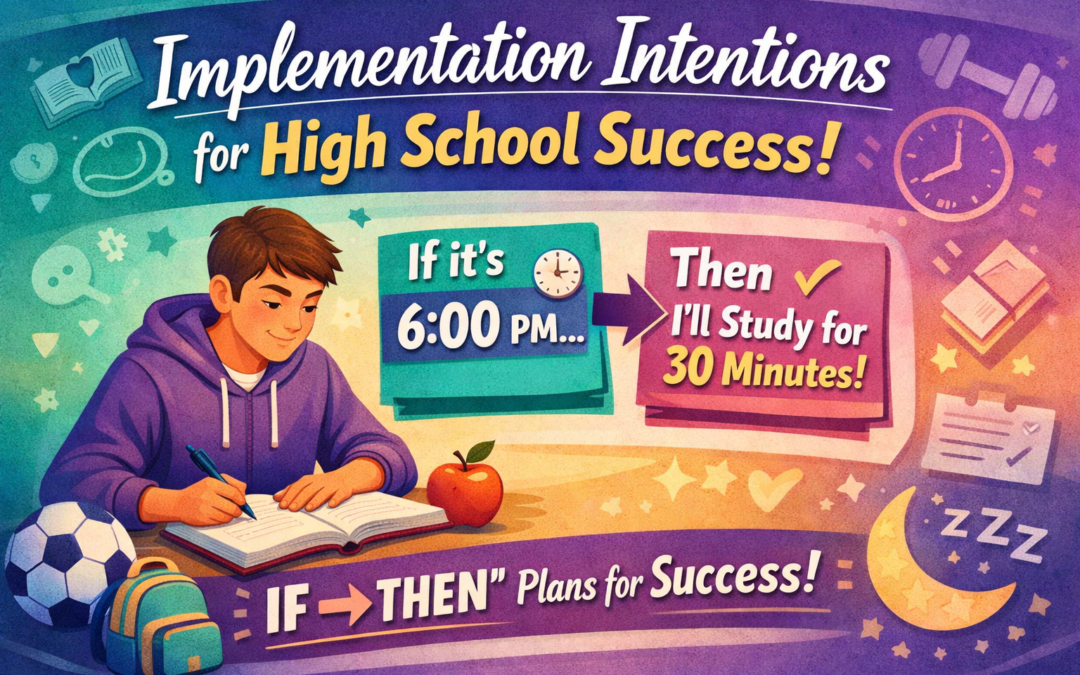
Implementation intentions are simple “if–then” plans that link a situation to a specific action.
The formula looks like this:
If (situation happens), then (I will do this behavior).
Instead of leaving your goals floating in your head, you tell your brain when and how you’ll act. It transforms vague ideas into concrete steps.
For example:
- Instead of saying: “I’ll study more for biology.”
- You say: “If it’s 6 PM on weekdays, then I’ll study biology for 20 minutes at my desk.”
Implementation intentions help your brain shift from “I hope I remember to do this” to “Oh — it’s time to do it.” The behavior becomes automatic, and you don’t depend only on willpower.
This tool isn’t about dreaming big — it’s about turning big dreams into tiny, doable actions.
Why Implementation Intentions Work
The idea comes from psychologist Peter Gollwitzer, who found that people who create if–then plans are far more likely to follow through on their goals. Why? Because this strategy reduces hesitation and decision-making pressure.
Normally, when it’s time to study or exercise, your brain starts negotiating:
- “Maybe later…”
- “I don’t feel like it right now.”
- “I’m tired.”
Implementation intentions get rid of the moment-to-moment debate. You already made the decision, so your brain has a direct path to action.
Studies show that when students decide in advance what they will do and when, they:
- Spend more time studying
- Procrastinate less
- Perform better on tests
- Stick with habits longer
It works for exercise, homework, healthy eating, time management — basically any area where you want to improve but struggle with consistency.
Implementation intentions turn effort into routine.
Example: Using It in High School
Let’s say you always procrastinate writing essays. You want to start early… yet somehow it becomes midnight the day before it’s due.
Instead of saying, “I’ll try to start my essay earlier this time,” you set an implementation intention:
If it’s Wednesday at 7 PM, then I will write my essay intro at the school library.
Now you have:
- a clear time
- a clear place
- a clear task
It’s no longer a giant job called “Write the essay.” It’s one small step. That tiny change lowers stress, reduces procrastination, and builds momentum.
Once you finish one piece, starting the next feels easier. And instead of panicking the night before, you spread your work out — which improves your writing and your mood.
Over time, these small steps add up to big progress.
How to Stay on Track
Even with implementation intentions, there are pitfalls to avoid:
❌ Being too vague
Plans like “I’ll study when I have time” rarely work.
Free time doesn’t magically appear — you must schedule it.
❌ Trying to do everything at once
If you make 15 intentions at once, you’ll burn out.
Start with one or two habits. Build consistency, then expand.
✅ Break goals into tiny steps
Instead of “do homework,” try:
- If it’s 4 PM, then I will do my history outline for 15 minutes.
Small actions lead to big change.
Conclusion
Implementation intentions are powerful because they give your goals structure. They help you rely less on willpower and more on preparation and routine. By pairing a situation with a behavior — an if-then plan — you turn wishes into actions and habits.
For busy high school students trying to stay on top of academics, activities, and life, this simple method can make a huge difference. Instead of hoping improvement happens, you create a pattern that supports success one step at a time.
So the next time you tell yourself, “I really want to get better at this,” follow it with a plan:
If this moment or situation happens, then I will take this action.
Small decisions now shape your future — and implementation intentions help you take control of that process with confidence and clarity.