
By: Ishita Singh
Introduction
We’ve all had moments where we hype ourselves up with big promises. We say things like, “I’m done procrastinating,” or “This semester, I’m getting straight A’s.” In the moment, it feels powerful. But a few days later, reality hits — we get busy, distracted, overwhelmed, and the goals we set start to fade into the background.
Why does that happen? Most of the time, the problem isn’t motivation — it’s clarity. Vague goals are hard to follow because they leave too much room for guesswork. That’s where SMART goals come in. SMART goals turn the idea of “doing better” into a plan that’s clear, specific, and actually doable.
What Are SMART Goals?
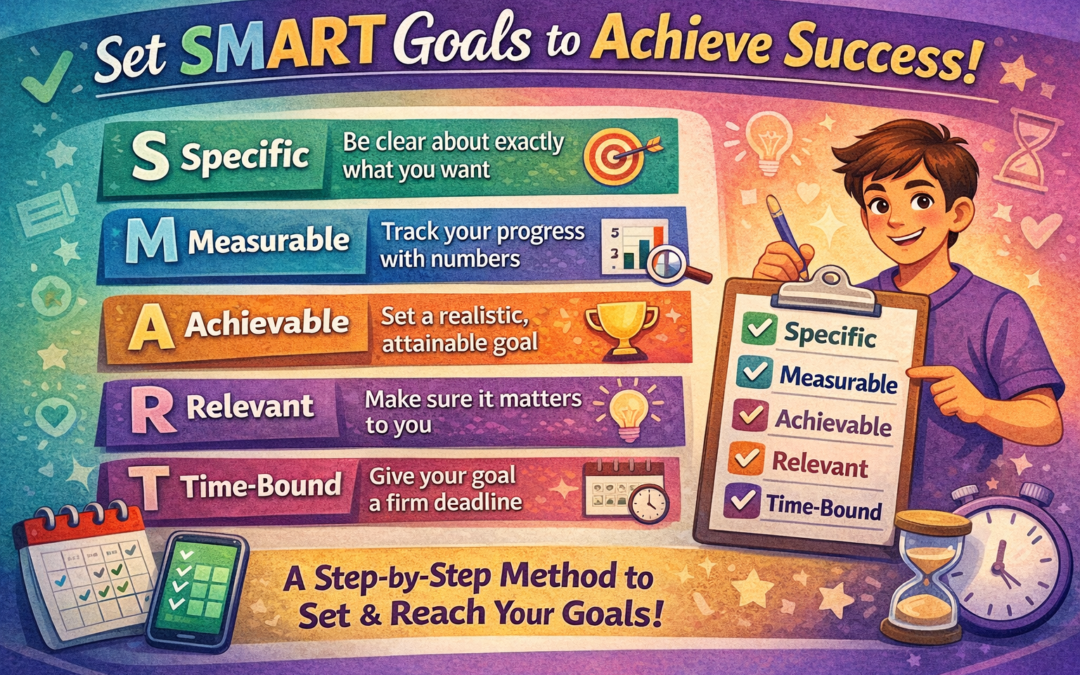
SMART is a step-by-step method to help you set goals you can actually follow through on. It stands for:
✅ Specific
What exactly do you want?
Be clear, not general. Instead of “I want to get fit,” try “I want to run three times a week.”
✅ Measurable
How will you track progress?
Maybe you check off days on a calendar, write in a notebook, or use a habit-tracking app.
✅ Achievable
Is this realistic for you right now?
It doesn’t have to be easy — but it should be possible with effort.
✅ Relevant
Why does this goal matter to you?
The more you care about it, the more energy you’ll put in.
✅ Time-Bound
When do you want to finish or check progress?
Deadlines keep your brain alert and motivated.
A Real Example
Instead of saying:
“I will get better at math.”
A SMART version might be:
“I will practice 10 algebra problems every night for one month to raise my quiz grades.”
Notice the difference?
One version is a hope.
The other is a plan.
SMART goals help you move from wishing to doing.
Why SMART Goals Work
There’s real science behind this method. According to psychologists Edwin Locke and Gary Latham, people perform significantly better when their goals are specific, challenging, and structured. Research across labs, classrooms, and real-world environments shows that in nearly 90% of studies, people improved more when using clear goals instead of vague ones.
SMART goals help your brain in three ways:
- ✅ They remove confusion — you always know what to do next
- ✅ They give you a sense of progress — you can see improvement
- ✅ They keep you accountable — there’s a set time frame
When your goal feels real and trackable, you stay more focused and committed.
How This Looks in Real Life
Imagine soccer tryouts are coming up and you realize your stamina isn’t where you want it to be. The thought in your head might be, “I need to get fit.” But that’s so broad that nothing usually changes.
A SMART goal sounds like this:
“I will run 1 mile three times per week and track my times until tryouts.”
You now have:
- A schedule
- A clear task
- A way to measure improvement
Instead of stressing about conditioning, you follow a plan — and you can literally see yourself getting better.
Common Mistakes to Avoid
Even with SMART goals, some mistakes can get in the way:
❌ Making goals that don’t match your lifestyle
If you normally go to bed at midnight, planning to wake up at 5 a.m. every day probably won’t last.
❌ Setting too many goals at once
Trying to transform your whole life overnight leads to burnout. Start with one strong goal. When you nail it, add another.
❌ Forgetting the “why”
If your goal doesn’t matter to you, it’s hard to stay motivated. Tie your goals to things that support your values, interests, or future plans.
Conclusion
SMART goals won’t magically guarantee success — but they give you a real blueprint for achieving what you want. They help you turn ambition into action, and action into progress. Instead of vague promises like “I’ll do better”, you create a clear path that guides you day by day.
The next time you set a goal, ask yourself:
Is it Specific, Measurable, Achievable, Relevant, and Time-Bound?
Leave behind the “someday” mindset.
Start making your goals concrete, trackable, and real.
Dreams are great — but SMART goals turn them into accomplishments.